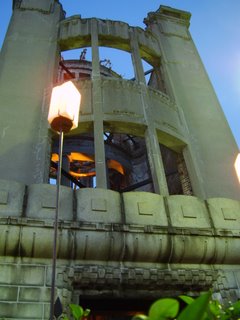
Sandwiched between the awesomely important events described in my posts below and above this one was the annual Hiroshima Day commemoration. I arrived in Hiroshima on the 6th August at 12:39 pm, which is 61 years and 4 hours and 24 minutes after Little Boy arrived in Hiroshima by Enola Gay, and laid waste to the city. While most cities in the world hold a Hiroshima Day commemoration (which is often hijacked by other movements or people concerned about minor brushfire conflicts going on at the time), Hiroshima has a rather more splendid and serious one, involving an entire day of various activities centred around the Peace Park, the A-Bomb Dome, and the rivers on each side. The A-Bomb dome is the old prefectural industrial Hall (or something similar), which was the closest building to the epicentre that wasn't more than just rubble, and the one you usually see in the middle of the famous aerial shots, such as (for example)
this one. It is also the building in my photo on this post. The Hiroshima day ceremony starts in the morning with a speech by various people (including, this year, the Famous Permed Man, Koizumi, aka "The Little Fascist", as many Japanese people supposedly call him). There is an obligatory release of doves, and various activities (which I missed) during the day. In the evening huge hordes of people turn out to the park to watch lanterns float down the river, and to draw on candles which are placed in lines along the pavements (you can see them in the picture above). There is singing, and some monks in a makeshift (?) temple doing a chant, and various other activities. Many, many people come to the park, and there are an enormous number of foreigners.
Hiroshima is, however, very far from a subdued city and although one can wander about town seeing evidence of the destruction on signposts in various places, one cannot really spend very long in Hiroshima and not be impressed by the locals' complete refusal to be glum about the events. Hiroshima is a gay and metropolitan city, the locals busy and cheerful, and they do not allow their morbid history to create a morbid atmosphere. I find the commemorative works here very positive and encouraging, focussing as they do on an end to all war and the abolition of nuclear weapons, and turning the epicentre of the destruction into a scene of quiet and peaceful contemplation. The museum is refreshingly honest and hopeful, even though its contents are quite disturbing; and the people seem to be very mindful of treating foreigners well, even though the foreigners do not always return the favour.
On this topic of treating foreigners well, the Delightful Miss E and I both heard a rumour before we came to Japan that one "should not go outside" on Hiroshima day, due to the abuse that one will cop. Never have I encountered a more ridiculous baka gaijin myth than this one, which could not be further from the truth. In fact, having come here and seen the way in which Japanese people ignore the war in their dealings with people they fought (e.g. Australians), I think such a myth is one of the nastiest and most destructive I have yet encountered. I have yet to meet a person in Japan who supports the right-wing revisionist view of the war, and yet to encounter abuse of any form, let alone such a specifically historically focussed attack. Many foreigners seem to think this represents the entire view that the Japanese have of the war, which can be quite a surprising idea once you see the diversity of opinion in this country.
So, against the backdrop of tireless Japanese patience and kindness, the Delightful Miss E and I wandered about the grounds which a mere 61 years ago had been reduced to flaming wreckage, jumping around the peace bell searching for frogs and wandering along the bridges and river banks taking photographs of the lanterns (some of which can be seen in the Illustrations). Along with us was most of the population of Hiroshima, going about things as the Japanese always do in large crowds without any antagonism or impatience. We could have written a message on a lantern to float down the river, but the queue was too long, so instead we just soaked up the pleasant atmosphere and took our time watching the people and the place. Given that I'm not really a pacifist, I have a small and faint belief that maybe the Americans were right in their reasons for using the bomb (at least, one of their reasons - not the one about 'experimenting'), and I have no hope that the world will ever be peaceful, my feelings about the whole issue of the bombing are kind of mixed. The Japanese seem to be almost universally completely opposed to war and proud of their army's special rules, and the time we live in here is called "The era of Peace", so they would probably not really agree with most of my opinions (but, thankfully, who does). Still, I have to agree with them - by any standards, Hiroshima is a unique tragedy, and it is as well that they have developed a unique way of commemorating it.
After this we repaired to a Spanish restaurant, where we ate snails and got drunk to celebrate my successful completion of my Japanese course. We walked home along the riverbanks and, lo and behold, further down the river at midnight we stumbled upon a workgang fishing the extinguished lanterns out of the river, obviously engaging in the usual Japanese zeal for recycling. The lanterns, along with their dreams of peace, had never reached the sea ...
 Here we see the Delightful Miss E posing with our rubbish before rubbish day. Matsue is famous for having the strictest rubbish rules in Japan, where you have to sort everything into its component parts. As a foreign student commencing at Shimane University I was taken to the rubbish processing plant, and I am therefore the proud bearer of all information one can know about Matsue rubbish. I am therefore qualified to inform my readers of all the contents of our rubbish separation system:


